
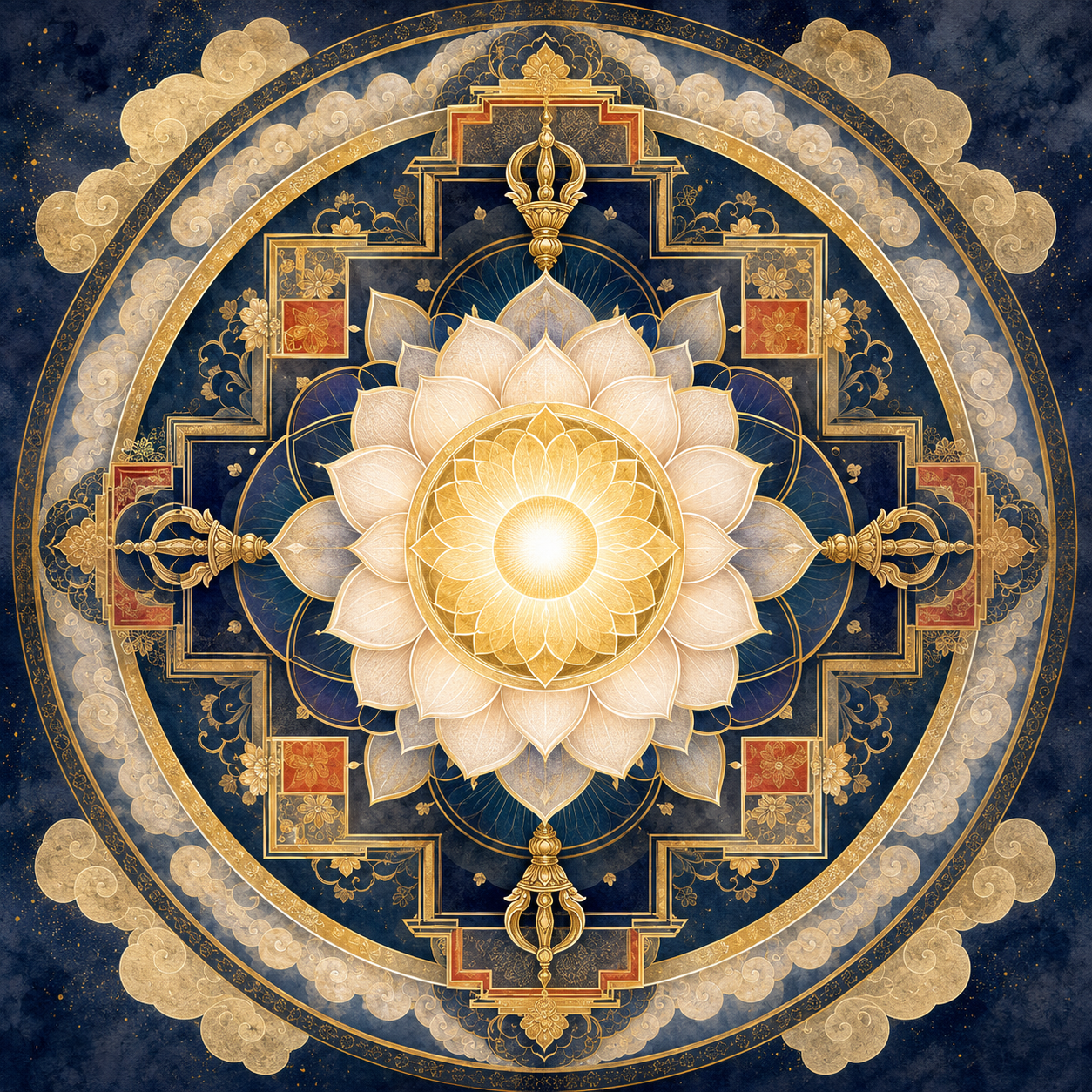
This mandala can be understood as a teaching on healing, Reiki and the natural state beneath all the movement of life.
It is not a formal historical mandala and it should not be presented as one. It is an original image inspired by esoteric Buddhist mandala structure: centre, lotus, palace, directions, cloud, light and sacred order. Its value is contemplative. It gives the mind and body somewhere to rest while pointing towards something deeper.
The centre
The first thing the eye meets is the radiant centre. This is the part of us that has not been damaged by experience. That does not mean we have not been hurt, frightened, exhausted, ill or changed by life. It means that beneath all of that, there remains a living centre that is not reduced to the difficulty we are passing through.
In Reiki terms, this can represent the natural state of Reiki within us. Reiki is not something pasted onto a person from the outside. It is not a substance that one person owns and gives to another. It is closer to the original condition of life itself: ordered, relational, responsive and whole. The light in the centre is therefore not a reward for meditating well. It is already there. The practice is not about creating it. The practice is about settling enough to recognise it.
The golden disc
Around the white centre is a golden disc. Gold has often been used in sacred art to represent what does not decay in the ordinary way. Here it suggests something enduring. Our moods change, our bodies change and our circumstances change.
The deeper nature of life is not so easily erased. The disc is circular because a circle has no beginning or end. It does not divide life into success and failure, spiritual and unspiritual, healed and unhealed. Everything belongs within it. This is important in a healing space. A person does not have to arrive peaceful in order to belong. Pain belongs, confusion belongs, fatigue belongs and joy belongs. The centre does not reject any of it.
The lotus
The pale lotus opens around the centre. A lotus is often associated with awakening because it grows from mud and water and still opens towards light. The mud is not an error in the story. It is part of the conditions that allow the lotus to grow. This is a powerful teaching for healing.
We often think healing means getting rid of the difficult parts. The lotus suggests something else. The difficult parts may be held, transformed and included. Grief can deepen compassion. Illness can alter the way we listen to the body. Exhaustion can expose where we have lived beyond our limits. Pain can become a teacher, though it should never be romanticised. The petals do not deny the mud. They reveal what can emerge through relationship with it. Each layer of petals can also be seen as part of the human being.
The body
The breath
The nervous system
The emotions
Thought
Memory
Relationship
Meaning
None of these exists alone
Healing is not one isolated part being fixed while the rest remains untouched. The whole person is involved.
The darker blue petals
Behind the pale lotus are deeper blue layers. These matter because without them, the image would become too bright, too perfect and too removed from real life. The dark blue represents depth. The unknown. The parts of ourselves we do not yet understand, the night, the unconscious and the periods of life when there is no clear answer.
In this mandala, the darker layers are not enemies of the light. They are part of the same structure. This means that difficulty is not outside the sacred. The darkness is not a failure of the practice. The centre remains present within it. That is a mature understanding of healing. We are not trying to become people who never feel fear, anger, grief or pain. We are learning not to lose our entire sense of self inside them.
The square palace
Around the lotus is a square, temple-like structure. In mandala symbolism, the square often represents a sacred enclosure or palace. Here it can be understood as the right conditions for healing. A person often cannot settle because the conditions around them do not feel steady enough.
The body remains alert
The breath stays shallow
The muscles brace
The mind continues scanning
The square represents structure
Boundary
Order
Containment without confinement
In the Reiki Support Circle, this is the condition being offered.
A steady hour.
A clear beginning and end.
A grounded voice.
A place where nothing is demanded.
A field in which the person can stop managing for a while.
This does not force healing. It makes healing more possible.
The four directions
The mandala extends in four directions. This gives a sense of wholeness.
North, south, east and west.
Above, below and around.
Body, mind, heart and life.
Past, present, future and the point from which we meet them.
The four directions remind us that no part of the person stands alone.
When one part changes, the whole pattern is affected. A deeper breath may alter the nervous system. A sense of safety may soften the muscles. Rest may change pain. Being seen may alter shame. A steadier body may make thought less chaotic and the healing is relational.
The vajra-like forms
At the four sides are forms inspired by the vajra. The vajra is often associated with strength, clarity and indestructibility. Here, this should not be understood as hardness. Real strength is not rigid. It does not mean becoming unaffected. It means there is something within us that can remain present without being shattered by every movement of experience.
The vajra-like forms point back towards the centre. They hold the pattern together. They suggest that clarity is not found by escaping life, but by meeting life from a deeper place.
The red panels
The red areas bring warmth and human life into the mandala.
Red is blood
Body
Heat
Earth
Embodiment
Without red, the image could drift into abstraction. The red reminds us that healing happens in a body.
In a home
In a family
In work
In illness
In ordinary human difficulty
The centre is not somewhere far away. It must be lived through the body.
The clouds
Around the outside are cloud forms. Clouds are never still. They gather, change shape, move and dissolve. They are like thoughts and emotions.
Like symptoms.
Like the changing events of life.
The cloud is real, but it is not permanent. This does not mean every difficulty passes quickly. Some remain for a long time but even then, our relationship with them can change. The clouds move around the mandala. They do not erase the centre.
The outer circle
The large outer circle holds the whole image. It represents completeness. Nothing is outside the field. The outer edge is not there to imprison the person.
It marks the whole.
It says: all of this belongs.
The centre and the cloud.
The light and the dark.
The body and the mind.
The pain and the capacity to heal.
The person as they are now.
The deeper teaching
The deeper teaching of this mandala is that healing is not about becoming someone else. It is often about coming back into relationship with what is already present. The centre has not disappeared. It may be covered by noise, fear, being overworked, by pain amd by the strain of carrying too much for too long.
The mandala does not ask the person to fight through those layers. It invites them to settle through them.
To breathe.
To feel the support beneath the body.
To let the scattered parts gather.
To allow the whole person to be met.
This is why the mandala is useful during the Reiki Circle. The eye rests at the centre. The body begins to organise around that point of steadiness. The image gives form to the condition you are creating through Reiki. Not a dramatic intervention.
A field of order
A steady centre
A place in which the person may begin to remember their own wholeness
A natural way to introduce it during the session would be:
Let your eyes rest on the centre of the mandala. The light represents the natural state within you that has not been lost, even when life has become painful, tiring or unsettled. The darker layers belong too. They represent the parts of life that are harder to understand or carry. Nothing has been excluded from the image. Let the centre remain steady while the breath moves, the body settles and the experience unfolds in its own way.
You are not trying to reach the light. You are allowing yourself to remember that it is already present.
How to Use the Mandala
Let your eyes rest gently towards the centre.
Allow the gaze to remain soft.
Bring the breath into the Hara, the lower abdomen.
You may use the mandala:
during the live Monthly Healing Circle
while listening to a session recording
as a focus for meditation
during a few minutes of rest
whenever you need a point of steadiness
There is nothing to force. Let the image become a place where the eyes, breath and attention can gather.